


There’s a conversation happening in every marketing meeting right now: Do we need to do AEO? Should we shift budget? Is SEO even still a thing?
I get it. The pace of change is real, and the headlines aren’t helping. But somewhere in the rush to optimize for ChatGPT, Perplexity, Claude, and Google’s AI Overviews, a lot of B2B companies are skipping the part that actually matters: the humans.
TL;DR:
- Humans are the center. SEO is a layer on top. AEO is a layer on top of that.
- You can’t skip the inside to get to the outside. AEO doesn’t work without SEO, and SEO doesn’t work without human-first content.
- The brands winning in AI answers are the ones that never stopped writing for people first.
The order has always been the same
Here’s the framing we keep coming back to with clients:
- Humans are the center.
- SEO is the layer on top of that.
- AEO is the layer on top of SEO.
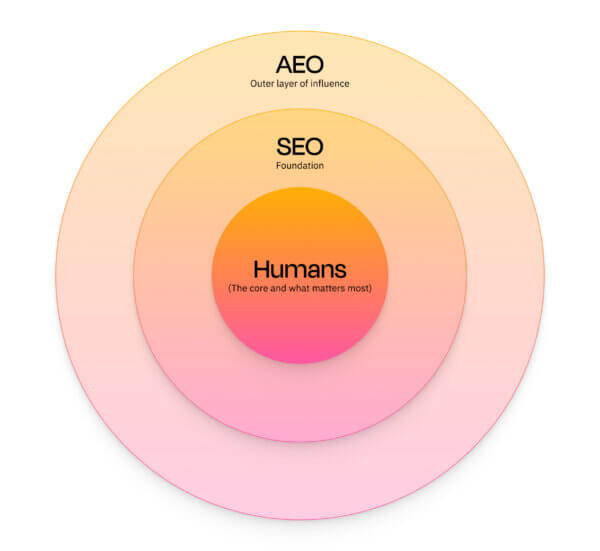
It builds outward, not inward. You don’t start with AEO and work your way back to the human. You start with the human and earn the right to be cited by everything else.
This isn’t a hot take. It’s how it’s always worked. Google has spent the last decade telling us to write helpful, people-first content. AI didn’t change that. AI just raised the cost of ignoring it.
Why AEO can’t stand alone
AEO isn’t a new channel. It’s not a new platform you log into and configure. It’s an expansion of the work you should already be doing, optimized for a new kind of reader, the answer engine. And answer engines are pulling from the same internet your humans are reading. They’re parsing the same pages, the same schema, the same structure.
If your underlying site doesn’t serve a human well, no amount of FAQ schema is going to make an LLM choose you.
You can’t do the outer layer without doing the inner layers.
What “human-first” actually means
This is where it gets practical. When I say humans at the center, I don’t mean vibes. I mean a specific set of choices that shape every piece of content your team creates.
- Clarity over cleverness. Can a busy CMO skim this page and immediately know what you do, who you do it for, and why it matters?
- Conversational structure. Does your content sound like how your best salesperson talks, or like a brochure from 2014?
- Real questions, real answers. Are you answering the questions your buyers actually ask, or the ones you wish they’d ask?
- Specific over generic. Are you saying something only your company could say, or could a competitor swap their logo in and run it tomorrow?
When that foundation is solid, SEO works because Google’s job is to find the most helpful page. And AEO works because LLMs are pulling from the clearest, most quotable, most trustworthy sources they can find.
Same foundation. Different audiences reading it.
SEO is the middle layer, and it’s still doing the work
Here’s the part that gets lost in the AEO hype: SEO didn’t go away. It got more important.
The technical foundations like site architecture, page speed, internal linking, schema markup, and keyword intent, are the rails that both Google and AI tools run on. When ChatGPT pulls from the web, it’s pulling from sites that were built to be crawled, indexed, and understood. The same things that made you findable in 2020 are what make you citeable in 2026.
So when someone tells you SEO is dead, what they’re really saying is they don’t understand how AEO actually works.
AEO is the outer layer, and it’s where you earn the citation
Once your content serves humans and your technical SEO is solid, AEO is the layer that makes you the answer.
This is the work we walk through in detail in our AEO Guide, but the short version: AEO is about being structured, specific, and quotable enough that an LLM picks you over the other ten companies that also offer what you offer.
That means:
- Question-based headlines that map to real buyer intent
- FAQ and How-To schema that makes your content easy to parse
- Clear, declarative answers that an AI can lift cleanly
- Strong brand signals across the web so you’re recognized as a trusted source
None of that works if the underlying content is thin, vague, or written for an algorithm instead of a person.
What this means for your team
If you’re trying to figure out where to put your next dollar, the framing is simple:
- Audit who you’re writing for. Open your top five pages. Are they written for a human you’d actually want as a customer? If not, fix that first.
- Then check your SEO foundation. Schema, structure, intent, speed. The unglamorous stuff.
- Then optimize for answer engines. Question formatting, citeable answers, FAQ pages, conversational tone.
In that order. Always.
Because humans started this. Humans are still buying from you. And humans are the ones who decide whether the answer an AI gave them was actually any good.
The final say still belongs to a person
It’s easy to forget, when we’re all knee-deep in optimization tactics, that there’s still a person on the other side of every search. Someone with a problem. Someone deciding whether to trust you. Someone who’s going to read what the AI cited and decide if it sounds like something they can actually work with.
AI is the new middleman. But the human is still the buyer.
Build for them first. Everything else is just a layer.

AI and the search landscape
Read More