
Modern B2B marketing:
How to drive revenue in an AI-first world

For B2B leaders who need marketing to drive pipeline, revenue, and retention in an AI-search world.
B2B marketing has changed
Modern B2B marketing has changed more in the last five years than it did in the fifteen before it. Buyers are self-educated, digital-first, and relying on AI tools to shape their shortlists long before they ever speak with sales. The companies winning today aren’t the ones doing more marketing. They’re the ones using brand, web, content, and data as a single, cohesive revenue engine.
This guide will show you exactly what modern B2B marketing requires, how AI search is rewriting the rules, and how to build a system that generates pipeline, accelerates deals, and proves ROI to the C-suite.
If your team feels the pressure to drive real revenue, not just activity, you’re in the right place.
TL;DR:
Modern B2B marketing has one job: to drive revenue.
And to do that, your strategy must match how today’s buyers actually search, evaluate, and make decisions. This guide shares how to do exactly that.
Who this guide is for
This guide is built for B2B leaders who are responsible for revenue, growth, and clarity, especially when marketing feels complex, fragmented, or underperforming.
For the Visionary / Owner
You want confidence that your marketing dollars are being used wisely and that your company is communicating clearly, competing strongly, and growing consistently. You’re looking for a modern approach that aligns the entire business (brand, web, and revenue) around real results.
For the COO / CFO
You care about efficiency, predictability, and ROI. You need marketing to be accountable, measurable, and integrated with operations, not a black box. This guide shows how modern marketing ties directly to pipeline, velocity, and financial performance.
For the CMO / Head of Marketing
You’re navigating high expectations with limited time and resources. You need strategy, clarity, and a partner that enhances your team’s capacity, not one that creates extra work. This guide gives you the frameworks, language, and structure to drive alignment and accelerate growth.
What is modern B2B marketing?
Modern B2B marketing is how a business creates revenue by helping buyers learn, evaluate, and make confident decisions, long before they ever talk to sales.
B2B marketing is no longer about pushing tactics or generating one-off leads. It’s about becoming the trusted source buyers rely on as they research independently, compare options, and validate solutions through AI-first search tools.
Today, buyers complete more than half of their decision-making journey before they ever speak to sales.
In short, modern B2B marketing exists to drive revenue. Brand clarity, audience trust, and authority are the key factors that help you achieve this goal. But this wasn’t always the case.
How B2B marketing has changed since 2020
Since 2020, B2B marketing has completely transformed. Buyers have taken control, technology has accelerated personalization, content is now radically more human, and sales & marketing have finally started operating as one revenue engine. We’ve gone from a seller-driven industry to a buyer-driven industry, and that has reshaped everything about how B2B companies must operate.
Here are the four biggest changes to B2B marketing since 2020:
1. The buyer is fully digital, self-educated, and in control.
2019:
Buyers relied on salespeople, trade shows, and vendor-controlled materials to understand their options.
2026:
Buyers trust Gartner, G2, peer recommendations, LinkedIn experts, and AI-powered research tools more than brand claims.
Marketing isn’t just generating “leads.” It’s publishing value-rich content that educates the entire buying committee on their terms.
What this means for your marketing:
Your job isn’t to chase buyers. It’s to be the place they trust when they’re already researching. This happens through content, video, thought leadership, and AI-ready answers.
2. Technology is driving personalization, scale, and precision.
2019:
Marketing automation = email drips and basic lead scoring. ABM was a buzzword.
2026:
AI generates insights at scale. Predictive analytics identifies accounts that are actively researching solutions. CRM, automation, and sales tools must share the same data to align the entire revenue team.
ABM is no longer “advanced.” It is B2B marketing.
What this means for your marketing:
Your stack must work as one system. Intent signals, AI tools, CRM data, and personalization need to power your campaigns, or your competitors will simply move faster.
3. Content is shorter, more visual, and more human.
2019:
The gold standard was long PDFs and dense case studies.
2026:
Short, valuable video drives the highest ROI. Executives and SMEs are the new “influencers” on LinkedIn. Buyers expect simple, human-focused storytelling that shows real business impact, not feature lists.
What this means for your marketing:
You need consistent, authentic content that speaks to real problems, showcases expertise, and builds trust. Forget the library of assets no one reads.
4. Sales and marketing are now a revenue team.
2019:
Marketing tossed over MQLs. Sales complained about quality. Everyone operated in silos.
2026:
RevOps = the standard. Teams operate under shared revenue goals. Customer success plays a bigger role because retention is now a marketing priority.
What this means for your marketing:
If your goals, metrics, and systems aren’t unified, revenue stalls. Modern B2B marketing requires shared dashboards, shared definitions, and shared outcomes.

Integrating sales and marketing to maximize revenue impact
Read more| Reality | 2019 | 2026 |
|---|---|---|
| Buyer Behavior | Sales-led | Buyer-led & AI-guided |
| Content | Long, gated | Short, visual, human |
| Technology | Basic automation | AI, intent, predictive analytics |
| Data | Fragmented | Unified & privacy-first |
| Team Alignment | Siloed | RevOps & shared metrics |
Key takeaway:
B2B buyers haven’t become harder to reach. They’ve become smarter. Your marketing needs to meet them in the places they research, the formats they trust, and the answers AI tools choose to surface.

Why the 2026 B2B Buyer Doesn’t Need You (Yet)
Read MoreHow AI search and answer engines are changing B2B marketing (and what to do about it)
For many B2B buyers, their journey now starts with an AI-generated response, not a Google results list. Whether they type a question into ChatGPT, scan a Perplexity summary, or read an AI Overview, the “answer engine” is shaping their shortlist before they ever reach your website.
Why this matters:
If your brand isn’t referenced in these answers, you’ve lost the buyer before your funnel even begins.
AEO vs SEO
AEO (Answer Engine Optimization) is how you make sure your brand appears inside AI-generated answers from tools like ChatGPT, Perplexity, and Google’s AI Overviews. While SEO helps you rank in traditional search, AEO helps you become the source AI tools quote—turning your expertise into the first impression buyers see.
AEO guide
Read moreContent must be “answer-ready”
AI systems favor content that is structured like…well, answers. That means your site must be built for machines and humans.
What modern B2B content needs:
- Clear questions as headers (H2/H3)
- Concise, factual 40–60 word summaries
- Schema markup (FAQ, HowTo, Product, Organization)
- Expert bios and bylines that reinforce authority
- Skimmable structures + strong internal linking
This is how you give AI models the exact material they need to confidently cite you.

Want to Show Up in AI Answers? Start Asking Better Questions.
Read MoreFirst-party data + owned web matter more than ever
AI search reduces reliance on paid channels and rented audiences. Your website and your data become the primary sources AI uses to understand and trust your brand.
This means:
- Clean, unified, privacy-compliant first-party data
- A technically sound, fast, accessible website
- Fresh, authoritative content tied to real business problems
- Deep topical coverage so AI sees you as a subject-matter authority
Your website is no longer just your digital front door. It’s your AI training source.
Your site should have:
- AI-ready site architecture: fast, structured, schema-rich
- Clear, Q&A-driven content hubs that answer buyer questions directly
- Brand messaging frameworks that AI recognizes and reuses
- AEO-aligned pages that match how modern buyers search
- First-party data ecosystems that strengthen personalization and reporting
Don’t guess what AI needs. Engineer your content and your website to become the most trusted answer.
Why this matters:
The way people search has changed, but the goal hasn’t: being the most trusted answer.
How B2B marketing differs from B2C (and why it matters for your plan)
B2B marketing focuses on long, multi-stakeholder buying cycles driven by ROI, risk reduction, and alignment. Instead of persuading one consumer, you’re educating an entire buying committee. The strategy, content, and website must build trust, prove value, and support a complex, research-heavy decision process.
Modern B2B marketing isn’t harder than B2C, but it is more complex. And today, that complexity includes buyer habits becoming more like B2C, even while the decision-making process remains uniquely B2B.
B2B buyers expect frictionless digital experiences, real-time information, and personalized content – the same way they shop, stream, and scroll at home. But behind that consumer-like behavior sits a larger truth:
In B2B, you’re not influencing one person. You’re influencing a buying committee, navigating budget cycles, risk thresholds, and long-term business impact.
That fundamental difference affects everything: your strategy, your message, your content, your website, your campaigns, and how you measure success.
Where B2B and B2C overlap (more than they used to)
Even though the buying dynamics differ, the behaviors are converging:
- Both expect intuitive digital experiences (fast sites, clear content, helpful UX)
- Both rely on reviews and social proof before talking to sales
- Both prefer short-form, human-centric content
- Both expect personalization based on behavior, not guesswork
These are important, but they are only the surface. Once you go deeper, the differences reappear quickly.
Where B2B differs from B2C
Unlike B2C, the focus is less on volume and more on quality and fit (leads that match your ICP – Ideal Customer Profile).
- Buying committees, multiple stakeholders v. individuals
- Rational, investment-oriented buying vs. consumer needs/wants spending
- Complexity of the journey and multi-touch attribution
- Length of sales cycles
- ROI expectation / Speed to ROI
| Category | B2C | B2B |
|---|---|---|
| Audience | Individual consumer | Buying committees (3–10+ people) |
| Decision Drivers | Emotion, desire, convenience | ROI, risk mitigation, alignment |
| Sales Cycle | Short, direct | Long, multi-stage, multi-touch |
| Attribution | Simplified, individual-level | Complex, multi-touch, account-level |
| Content Needs | Fast, entertaining, persuasive | Deep, educational, trust-building |
| Website Role | Primary storefront | Conversion engine + proof source |
| Personalization | Behavioral + preference-based | Intent-based, ABM, segmented |
Why this matters:
Modern B2B marketing must serve multiple decision-makers, not just one clicker. You’re marketing to a group of evaluators, each with different needs, risks, and motivations.
This means your B2B marketing must:
- Educate multiple stakeholders, not just appeal to one.
- Build trust early, long before sales ever enter the conversation.
- Connect every channel (brand, web, content, paid) into a cohesive buyer experience.
- Prove ROI with metrics that matter to leadership, not vanity numbers.
- Be structurally ready for AI search, where answers must be clear, factual, and unambiguous.
The more aligned your marketing is to the real buying process, the easier it becomes to generate demand, accelerate deals, and fuel long-term revenue.
The 5 core challenges of modern B2B marketing
What are the biggest challenges in modern B2B marketing?
Modern B2B teams struggle with proving ROI, aligning revenue teams, generating qualified demand, leading digital experiences with brand clarity, and keeping up with AI search and data privacy shifts. These challenges stem from digital-first buyers, fragmented data, and rapidly evolving expectations.
Modern B2B marketing isn’t hard because teams lack effort. It’s hard because the landscape has changed faster than most companies have adapted. Buyers are fully digital, data is fragmented, AI is reshaping how information is found, and revenue teams are expected to operate as one. These five challenges show up in nearly every B2B organization today—and solving them is the difference between “activity” and actual revenue growth.
Below are the core challenges B2B leaders face today, why they matter, and how modern teams overcome them.
- Proving ROI and attribution
- Aligning revenue teams (Sales/Marketing/Success)
- Generating qualified demand, not noise
- Building a brand that leads digital experiences
- Keeping up with AI search, data, and privacy shifts
1. Proving ROI and accurate attribution
Why it’s a challenge:
The B2B buying cycle is long, nonlinear, and crowded with touchpoints. Deals often involve months of research, multiple decision-makers, and a mix of channels (web, email, social, events, outbound). This makes it incredibly difficult to connect marketing activity to revenue with confidence.
The problem:
- Data lives in disconnected systems (CRM, website, ads).
- Last-click or first-click models hide what’s actually influencing the buyer.
- Marketing struggles to justify budgets without a clear revenue story.
The shift:
B2B teams are moving toward multi-touch attribution, integrated data, and measuring what truly matters—pipeline influenced, velocity, deal quality, and cost per Sales Qualified Opportunity (SQO).
What modern teams do instead:
- Build shared dashboards across marketing + sales.
- Track outcomes tied to revenue, not vanity metrics.
- Prioritize high-intent content and channels that show real contribution to pipeline.

How to measure B2B marketing in 2026
Read more2. Aligning revenue teams (sales, marketing & customer success)
Why it’s a challenge:
Marketing and Sales often operate on different definitions, targets, and expectations. Marketing delivers MQLs that Sales doesn’t prioritize. Sales asks for content Marketing didn’t know was missing. Customer Success has insights neither team sees.
The result? Slow deals, inconsistent messaging, and missed revenue.
The problem:
- Misaligned definitions of ICP, MQL, SQL, and “qualified”
- No unified view of buyer activit
- Content gaps that disrupt the sales cycle
The shift:
Modern companies are adopting RevOps – one shared revenue goal, one shared set of tools, and one version of the truth.
What modern teams do instead:
- Align around Sales Qualified Accounts, not just leads
- Map content to the entire buying committee
- Ensure seamless handoffs across every stage of the buyer journey

What RevOps means for high-growth B2B teams
Read more3. Generating qualified demand (not just more leads)
Why it’s a challenge:
It has never been easier to produce content, but harder to get the right audience to care. Buyers complete 80% of their research independently through third-party sources like Gartner, G2, and LinkedIn communities. By the time they talk to Sales, they’re already informed.
The problem:
- Digital saturation makes it difficult to stand out
- Broad lead gen produces noise, not pipeline
- Most content feels generic and interchangeable
The shift:
High-performing teams prioritize ICP-first demand generation, human-centric thought leadership, and Account-Based Marketing (ABM), all built around real buyer needs.
What modern teams do instead:
- Invest in expert-led content (execs, SMEs, practitioners)
- Use ABM to focus on fewer, higher-value accounts
- Create content that reduces friction (proof, demos, educational frameworks)

How to generate demand in a saturated B2B landscape
Read more4. Building a brand that leads digital experiences
Why it’s a challenge:
In a self-service, digital-first buying environment, your brand has to work long before your sales team ever gets involved. Your website, social proof, thought leadership, and digital UX are the sales conversation.
The problem:
- Inconsistent digital experiences erode trust
- Brand messaging rarely matches what buyers actually search for
- Companies underestimate the role of brand in high-value, rational purchases
The shift:
Brand is becoming the blueprint for the entire digital experience, from website structure to content strategy to executive thought leadership.
What modern teams do instead:
- Treat brand and digital transformation as one initiative
- Build credibility through expertise, proof, and consistency
- Prioritize “human-centric” content that connects expertise to outcomes

How brand drives digital trust in B2B marketing
Read more5. Keeping up with AI search, data, and privacy shifts
Why it’s a challenge:
AI-first search has fundamentally changed how B2B buyers discover solutions. Meanwhile, data privacy laws and the loss of third-party cookies have made targeted marketing harder than ever.
The problem:
- AI tools synthesize answers instead of listing links
- First-party data is now the only durable data asset
- Buyers expect more personalization but want more privacy
The shift:
Marketing teams must adopt AEO (Answer Engine Optimization), first-party data strategies, and content built for both humans and machines.
What modern teams do instead:
- Create “answer-ready” content (clear questions + clear answers)
- Implement unified data systems (CRM)
- Build AI-ready websites and content structures
- Treat data privacy and transparency as part of the brand promise
AEO guide
Read moreKey takeaway:
Winning teams solve these modern marketing challenges by shifting from reactive, tactical spending to proactive, strategically integrated marketing. They align revenue teams, measure what matters, focus on high-converting assets like the website, and operate on a steady cadence (revisiting their marketing plan every 90 days).
Framework – how to build a modern B2B marketing engine (Syrup POV)
What is a modern B2B marketing engine?
A modern B2B marketing engine unifies brand, website, demand generation, and measurement into one system. It replaces random tactics with a structured, revenue-centered framework built on positioning, an AI-ready website, integrated campaigns, and continuous optimization through shared KPIs and 90-day cycles.
Modern B2B marketing breaks when it’s treated as a list of disconnected tactics. Leads stall. The website underperforms. Sales blames marketing, marketing blames data, and executives lose confidence. A modern B2B marketing engine fixes that by unifying everything. One framework designed to drive revenue with clarity, consistency, and accountability.
The modern B2B revenue engine
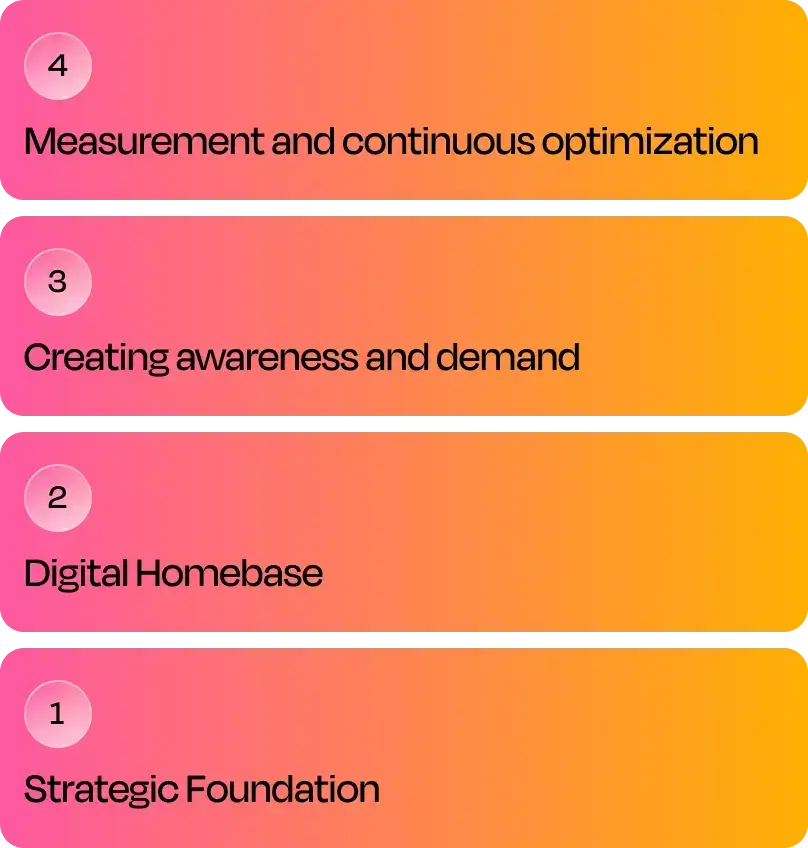
1. Strategic foundation
- Positioning
- Messaging
- ICP
- Brand clarity

Brand identity: Stand out or go away
Read more
Embrace the humanity in B2B branding
Read more
Why an outdated brand could be silently killing your sales
Read more2. Digital home base → website + WebOps
- Technical SEO
- AEO
- Accessibility
- Fast, structured, updated

The hidden cost of a weak website
Read more
A modern website launch isn’t the finish line
Read more3. Demand: awareness → conversion → nurture
- Content (blogs, LinkedIn, thought leadership)
- ABM
- Social proof
4. Measurement & continuous optimization
- Dashboards
- 90-day cycles
- Shared KPIs
- Forecasting with marketing data

90 march with 2020 vision
Read moreMeasuring success in B2B marketing (for CEOs, CFOs, and COOs)
How do you measure B2B marketing success?
You measure it by how effectively marketing drives revenue outcomes — not activities. Success shows up in pipeline velocity, high-value conversion rates, customer retention, and overall revenue efficiency. The goal isn’t more marketing. The goal is a measurable impact on growth, margins, and momentum.
Why measurement matters more in modern B2B
The B2B buying journey is longer, more complex, and more distributed across channels than ever. That means old models — last-click attribution, isolated campaign metrics, “MQL counts,” or activity dashboards — no longer reflect what’s driving revenue. Leaders need clarity, not noise.
Syrup would advise moving away from measuring random activities and toward measuring data that directly informs a business decision or revenue goal.
What CEOs, CFOs, and COOs really want from marketing reports
Executives aren’t looking for more data. They’re looking for decision-making clarity.
That means your reporting should:
- Connect directly to revenue and company goals
- Focus on outcomes, not channels
- Provide actionable context (“What happened, why it happened, what we should do next”)
- Show efficiency gains, not just activity increases
- Tell a concise and credible story
This is where Syrup’s Objectives-Based Marketing and 90-day operating rhythm shine — turning marketing performance into predictable, measurable business impact.
What to measure, when, and why
Move away from measuring random activities and toward measuring data that directly informs a business decision or revenue goal.
| What to Measure (The Data) | When to Measure | Why it Matters (The Purpose) |
|---|---|---|
| P&L and Sales Data | Annually, Quarterly, and YTD | Foundation: Provides the starting point for all planning (Where are we financially?) and serves as the ultimate benchmark for all marketing activities. |
| Pipeline Velocity & Efficiency | Monthly & Quarterly | Predictive: Measures the speed at which qualified leads move through the funnel (e.g., from MQL to Closed-Won). This is a critical shared metric that proves marketing’s ability to accelerate revenue. |
| High-Value Conversion Rates | Weekly & Monthly | Optimization: Measures conversion percentages at high-friction points (e.g., website visitor > lead, demo request > Sales Qualified Opportunity). This data dictates where budget should be reallocated for better efficiency. |
| Client Retention / LTV | Quarterly & Annually | Growth: Marketing doesn’t stop at the sale. Measuring Customer Lifetime Value (LTV) and churn by segment proves marketing’s influence on the post-sale experience (e.g., through content that drives product adoption). |
| Campaign Performance by Segment | Post-Campaign & Monthly | Adaptability: Measures the effectiveness of messaging against specific audiences or target accounts (ABM). This allows for quick, intelligent adaptation to “evolving market dynamics.” |
The KPIs that matter (and focus on revenue impact)
The most important KPIs connect positioning, enablement, and adoption to revenue impact. Shift your focus away from Vanity Metrics (like impressions) and toward Value Metrics that Sales and the C-suite care about.
| KPI Category | Key Metrics | Why Syrup Focuses Here |
|---|---|---|
| Financial & Ultimate Goal | Revenue (Sourced/Influenced), CLV (Customer Lifetime Value), CAC (Customer Acquisition Cost) | These are the ultimate business metrics. Marketing’s performance is tied directly to the bottom line, demonstrating its role as a revenue driver. |
| Alignment & Efficiency | Pipeline Influenced/Sourced, Win Rate Improvement, Sales Cycle Length/Deal Velocity | These are shared metrics that eliminate the “us vs. them” Sales/Marketing rivalry. They prove that marketing provides the right leads that close faster. |
| Demand & Conversion | Sales Qualified Opportunities (SQOs), Cost per SQO, Conversion % (MQL → SQO) | SQOs are strongly indicative of incoming revenue. Focusing on cost per SQO is a more accurate measure of campaign success than cost per MQL. |
| Customer Success | Feature Activation or Engagement Rate, Churn by Segment | In B2B SaaS, this shows that marketing is successfully educating customers post-sale, leading to stickiness and higher renewal rates. |
How to present ROI to leadership
Presenting ROI is not about throwing data at executives; it’s about telling a concise, compelling, and business-relevant story. The goal is to frame all marketing outcomes as a structured narrative.
The presentation framework:

1. Link to business goals (the “Situation”)
Advice:
Start by re-stating the company’s ultimate goal (e.g., “Our goal for Q3 was a 15% increase in annual recurring revenue from the North American segment.”)
Why:
This establishes immediate context and shows that marketing reports ladder up to the CEO’s objectives, avoiding the perception that marketing is “frivolous.”
2. Focus on high-impact metrics (the “Result”)
Advice:
Use minimal jargon and focus on just one or two main takeaways that directly relate to dollars.
Bad:
“We increased CTR by 500 basis points.”
Good:
“We improved the Win Rate in the Financial Services vertical by 10 points, resulting in an estimated $2.5 million in accelerated pipeline value.”
Why:
Senior leaders are often time-constrained and focused on the bottom line (revenue, profit, cost).
3. Provide context and compare (the “So what?”)
Advice:
Show results relative to something meaningful.
- Compare the result to the Goal set at the beginning of the quarter.
- Compare to Past Performance (e.g., “This quarter’s CAC of $1,200 is a 20% improvement YOY.”)
- Compare the ROI (e.g., “For every $1 invested in content marketing, we saw a $5 return in influenced pipeline, up from $3.50 last year.”)
Why:
Numbers without context are just numbers. Context gives them weight and meaning.
4. Keep it concise and actionable (the “Next step”)
Advice:
Ask the “So What?” question before including any metric. If you can’t tie it to a strategic decision, move it to the appendix. Conclude with a clear call to action (e.g., “To maintain this trajectory, we recommend reallocating 15% of the display ad budget to expand our ABM content team.”)
Why:
Concise reporting is respectful of executive time and reinforces the strategic purpose of the marketing team.

Why Proving Marketing ROI Is So Hard (and How to Fix It)
Read MoreHow we bring B2B marketing to life with clients
Modern B2B marketing only works when strategy, execution, and accountability move together. That’s why Syrup doesn’t operate like a traditional agency. We build a marketing engine with you. Then we run it with the same ownership, clarity, and cadence you’d expect from an internal team.
How does Syrup help companies grow with modern B2B marketing?
Syrup builds and runs a complete marketing engine aligning brand, website, content, and demand into one revenue system. We operate with owner-level clarity, an AEO-first approach, and a 90-day operating rhythm that delivers momentum, measurable progress, and confident decision-making.
What makes Syrup different
Syrup builds and runs a complete marketing engine aligning brand, website, content, and demand into one revenue system. We operate with owner-level clarity, an AEO-first approach, and a 90-day operating rhythm that delivers momentum, measurable progress, and confident decision-making.
1. Objectives-based, revenue-centered marketing
We start with business goals, not vanity metrics. Every dollar, asset, and campaign is tied to revenue impact. We guarantee the best use of your marketing capital.
2. Brand + web + ongoing marketing under one roof
No handoffs. No silos. Your brand strategy, website, content, campaigns, and analytics all operate through a unified system built for B2B growth.
3. AI-search & AEO-first point of view
Your buyers are finding answers in AI tools before they ever hit Google. We structure your brand, website, and content to show up where decisions begin.
4. A 90-day operating rhythm
This is where momentum comes from. Every quarter, we align on goals, plan the work, ship quickly, measure honestly, and optimize. No random acts of marketing, just consistent, confident progress.
Let’s build a marketing engine that actually drives revenue.
Modern B2B marketing frequently asked questions
What is modern B2B marketing?
Modern B2B marketing is the strategic engine that generates revenue by educating buyers long before they talk to sales. It blends brand, web, content, and ongoing campaigns into a single, cohesive revenue system. In today’s AI-first landscape, it must also be answer-ready, clear, factual, and structured for both humans and machines.
How is B2B marketing different from B2C?
B2B marketing is built for complex, multi-stakeholder decisions, not one consumer impulse. It focuses on long sales cycles, ROI-driven messaging, and nurturing entire buying committees. Some tactics overlap with B2C, but the level of rigor, education, and trust required in B2B is dramatically higher.
What should a modern B2B marketing strategy include?
A complete strategy includes:
- Brand clarity and positioning
- A high-converting, AEO-ready website
- Ongoing demand creation and nurturing
- Measurement tied directly to revenue
If one piece is missing, results stall, especially in competitive, digital-first categories.
How do I know if my B2B marketing is working?
Your marketing is working if it’s creating pipeline your sales team actually wants and accelerating revenue, not just generating activity. Look for improvements in SQOs, win rates, sales cycle length, and retention. If you can’t tie marketing directly to revenue outcomes, you have a measurement problem, not a performance problem.
What KPIs matter most to the C-suite?
Executives care about:
- Revenue influenced / sourced
- Pipeline velocity
- Sales cycle length
- CAC and CLV
- Win rate improvement
Everything else (impressions, clicks, downloads) is only helpful if it supports one of these outcomes.
How long does it take to see results from B2B marketing?
Most B2B companies start seeing meaningful momentum in 90–180 days, depending on industry, complexity, and maturity. Brand and web improvements compound long-term, while campaigns and content begin producing quicker wins. The fastest improvements come when marketing and sales align around the same revenue story.
Do I still need SEO in an AI-powered search world?
Yes, but SEO alone isn’t enough. AI search tools now summarize answers instead of listing links, so your content must be structured for AEO (Answer Engine Optimization). That means clarity, Q&A formatting, unique data, expertise, and schema. SEO gets you indexed; AEO gets you chosen. Read more in our AEO Guide here.
What is AEO (answer engine optimization)?
AEO is how you make your brand the trusted answer inside tools like Google AI Overviews, ChatGPT, and Perplexity. It requires concise answers, structured content, expert bios, and strong first-party data. In many industries, AEO visibility now drives more pipeline than traditional search. Read more in our AEO Guide here.
How do we generate better B2B leads — not just more leads?
Stop optimizing for volume. Start optimizing for fit. Use ICP clarity, intent data, ABM, and conversion-focused content to attract the right accounts, not random email addresses. High-quality demand is the result of precise messaging, consistent thought leadership, and a website built to educate, not overwhelm.
Why is our website such a big deal for B2B marketing?
Your website is now your 24/7 salesperson. Buyers complete most of their evaluation before they ever talk to sales, which means the site must clearly answer their questions, show your value, and guide them smoothly to the next step. In AI search, your website is also how machines learn to trust you. Read more about Syrup’s AI Visibility services here.
How do we prove ROI to the board or investors?
Tie every marketing activity to the metrics executives actually care about: pipeline, velocity, win rates, and revenue. Present results using clear narrative: Context → Action → Impact → Next Step. If you tell a business story instead of a marketing report, leaders listen, and budgets grow.
Should we hire a B2B marketing agency or build internally?
If you need strategic clarity, faster execution, specialized skills, or help navigating AI search, an agency accelerates everything. Internal teams excel at product expertise and institutional knowledge. The strongest B2B programs blend both: internal ownership + external specialists who bring process, perspective, and horsepower. You can read more about our services here.
Glossary
AEO (Answer Engine Optimization)
AEO is the practice of optimizing your content so AI tools like ChatGPT, Google AI Overviews, and Perplexity cite your brand as the trusted answer. It focuses on clear questions, concise answers, schema markup, and authoritative content so you become the source AI uses to inform B2B buyers.
ABM (Account-Based Marketing)
ABM is a targeted B2B marketing strategy that focuses on engaging and converting specific high-value accounts rather than broad audiences. It aligns marketing and sales around shared account lists, personalized messaging, and coordinated campaigns built to influence entire buying committees.
ICP (Ideal Customer Profile)
Your ICP is the detailed description of the company that is the best fit for your product or service. It includes firmographics, challenges, buying triggers, budget, and success criteria — helping your marketing focus on the highest-value, highest-propensity accounts.
RevOps (Revenue Operations)
RevOps is the unified operating model that aligns Marketing, Sales, and Customer Success around shared data, shared tools, and a shared revenue goal.Instead of siloed teams, RevOps creates one seamless revenue engine with consistent processes, metrics, and accountability.
Intent Data
Intent data is behavioral information that shows when accounts are actively researching a problem, solution, or competitor. It reveals which companies are “in market” and helps teams prioritize outreach, personalize campaigns, and focus effort where buying interest already exists.
First-Party Data
First-party data is information your business collects directly from prospects and customers through your website, CRM, email, or product usage. It’s the most accurate, privacy-compliant data source — and the foundation for personalization, attribution, and AI-ready marketing in a post-cookie world.
Multi-Touch Attribution
Multi-touch attribution measures how different marketing and sales interactions collectively influence a deal. Instead of giving credit to only the first or last touch, it shows the full journey — helping teams understand which channels and content actually generate revenue.
Buying Committee
A buying committee is the group of stakeholders involved in a B2B purchase decision, usually 3–10+ people. Each member has different needs, risks, motivations, and approval power, which is why B2B marketing must educate multiple roles, not just one buyer.
Revenue Engine
A revenue engine is the integrated system that drives pipeline, conversion, and retention by aligning brand, web, demand, and measurement. It turns disconnected marketing and sales efforts into one predictable, measurable growth system — the core of modern B2B marketing.
WebOps
WebOps is the practice of continuously improving your website’s performance, structure, SEO, AEO, UX, and conversion rates. It treats the website as a living revenue engine — not a one-time build — so it stays fast, structured, search-ready, and aligned with buyer needs.
How this fits in overall B2B marketing strategies
A complete B2B marketing strategy is more than just knowing and implementing AEO. We’ve written an entire guide on Modern B2B Marketing and how to drive revenue in an AI-first world here.